Deel 1
mprove Breathing
By: Michele Ferrari
Published: 9 Oct 2013
Graeme Obree, an Absolute Genius whom the UCI smothered and buried, describes and recommends in his book "The Obree Way" an interesting breathing technique developed by him over the years.
Already in my article "Pulmonary Breathing" dated 09/06/2005, I emphasized how very often athletes, even top-level ones, do not breathe efficiently especially under intense effort (Med Sci Sports Exerc 2000, 32:926-932).
Obree observes how often cyclists under effort instinctively tend to gasp and generally breathe in a not very efficient way, in particular by not emptying the lungs completely during exhalation.
This means that residual air, low in O2 and rich CO2, mixes with fresh air rich in oxygen, consequently "impoverishing" alveolar pulmonary gas exchange.
Graeme therefore describes his technique which includes three breath cycles to be repeated in succession:
- start with a FULL EXHALATION to empty the lungs from residual air
- proceed with a deep inspiration to "fill up with fresh air"
- continue with the second respiratory cycle (exhale-inhale) which will have a depth half of the first
- the third cycle will have a further lower depth
- finally resume the sequence again with a full exhalation and deep inspiration.
Obree recommends to focus particularly on the diaphragm, which must "pump up the lungs like a bellows", especially in the exhalation phase.
He suggests to exhale with your mouth and breathe in with your nose and mouth together.
He further points out that this breathing technique should be trained for at least a month, so that it becomes automatic, and states that if properly applied it is able to improve the aerobic performance by 3-8 %.
A recent article (Exp Physiol 2012; 97:311-318) reports that the cost of breathing for top-level athletes can be up to 15-16% of VO2max, when engaged in an intense effort.
This explains, at least in part, the suggestion of Obree to limit oneself to a forced exhalation-inhalation every three breathing cycles, in order to reduce the energy cost of breathing.
The same article emphasizes the importance of respiratory muscle fatigue, which is the cause of a vasoconstrictor reflex on the muscles of the lower limbs (see also J Physiol 2000, 529:493-504), effectively restricting the flow of blood and thus oxygen.
This observation draws attention to the opportunity of training the respiratory muscles, but this deserves another article.
Other
Improve Breathing - Part II
By: Michele Ferrari
Published: 10 Nov 2013
What do Paula Radcliffe and Chris Froome have in common, in addition to being British?
Both adopt a special breathing technique, very similar to each other.
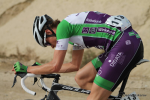
Looking Froome in action on the Mont Ventoux during the TdF 2013, one can't help but notice that the English cyclist rhythmically lowers his head, with a frequency that tends to increase along with the pace of the riding: every 5-7 seconds when the effort is moderate, every 2-4 seconds when he attacks, as he did 5-6 km from the finish line on the French mountain.
Some observers have attributed these movements of the head to the obsessive need of "robo-athlete" to check watts and heart rate from the SRM mounted on the handlebar.
I disagree: any lowering of the head by Froome corresponds to a forced expiration, implemented with a special technique.
Bowing the head facilitates the elevation of the diaphragm, further encouraging the complete emptying of the lungs: the anterior myofascial tension (from the jaw to the symphysis pubis), proper of the position in hyperextension of the head of the rider looking forward, is in fact reduced, thus facilitating the full expiration.
A complete elevation of the diaphragm reduces the intra-abdominal pressure, effectively promoting the venous and lymphatic return from the lower limbs, whose action, relieved from toxic elements, becomes "lighter".
The next deep breath, made through the nose and mouth and with the head in hyperextension (looking forward for the cyclist, up slightly for the runner), in addition to oxygenate the air in the lungs, reduces the endothoracic pressure by increasing diastolic filling and cardiac output and therefore the amount of oxygen that gets to the muscles.
When the effort is moderate forced expiration-inspiration occurs every 3-4 breaths (as suggested by Obree), when the effort is high every 1-2 breaths (as done by Froome during his attack on the Ventoux).
I tried this technique on myself in the past few weeks: I noticed that lowering the head the full diaphragmatic expiration is easier, and if you ride at high RPM (like Froome... ), each exhalation is accompanied by a 15-20% increase in instantaneous watts (better venous return? Less myofascial tension?).
I believe that this breathing technique, adequately trained and associated with a strengthening of the respiratory muscles, may bring advantages over an "uncontrolled" breathing , so frequent even among top athletes.









 Dat is wel een beetje gevaarkijk...